|
The
route of the ancient Pescasseroli-Candela sheep track, for long
stretches flanked by the SS. 17 state road, reveals traces of a great
historical and architectural patrimony. With its multi-coloured marbles,
silver busts and works held in its crypt, the Church of Santa
Cristina, at Sepino (11th-17th C.), is,
together with the Convent of the Holy Trinity (17th
C.), the sacred emblem of the local architectural heritage, given to it
by the Samnite settlement of Saipins and by the Roman Municipium
of Saepinum.
|
|

|
|
|
|
|
|
|
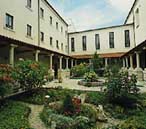
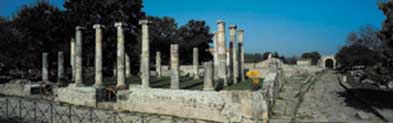
Sepino
- Crypt of the Church of S. Cristina - Convent of
the Holy Trinity - The sacred emblem of the local
architectural heritage. |
In
nearby Bojano, the Lombard-Norman castle of Civita soars over the
Cathedral of San Bartolomeo (11th – 13th
C.), with its interesting sculptures and medieval crypt, and over the Churches
of Sant’Erasmo (13th C.) and Santa Maria del
Giardino (13th-14th C.).
|
|

|
|
|
Bojano
- The Cathedral of S. Bartolomeo |
Still travelling along the SS. 17, against a backdrop of wood-covered
mountains, we come in sight of the neo-Gothic structure of the Santuario
di Castelpetroso, which preserves some notable works of art. Just
a few kilometres separate Castelpetroso from Isernia. In the area
surrounding the city, perched on a hill, we find the Hermitage of the
Saints Cosma and Damiano with its characteristic drum shape (11th
C.), built over a site which in ancient times Priapean rites were
practised.
|
|

|
|
|
Isernia
- Hermitage of the Saints. Cosma e Damiano |
The
oldest and internationally best known abbey is to be found at Rocchetta
al Volturno.
The
close-by town of Venafro also boasts ancient origins. The remains
of a Roman amphitheatre and an imposing castle are proof of a
flourishing and lively past, as are the Romanesque-Gothic cathedral,
the baroque Church of the Annunziata, the Rococo-style
Church of the Immacolata and the 17th century Santa
Chiara.
|
|
|
|

|
|

|
|
|
Venafro
- The Cathedral - The Church of the Annunziata |
|