|
One
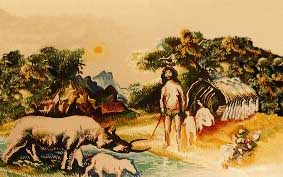
of the first inhabitants of Southern Italy, the Homo Aeserniensis,
lived about seven hundred thousand years ago, by hunting and fishing.
Close by a small watercourse he had built huts using elephant tusks and
the flat bones of rhinoceroses, boars, bison and other wild beasts. He
was a homo erectus, organised into groups.
The
settlement was discovered in 1978. It was then explored by the scholars
of the University of Ferrara. Some of the finds were removed from the
place in which they found - the Pine-wood – and put on display
in the Museum of Santa Maria delle Monache, at Isernia,
where they are still on display. Here the fossil plain has been
re-constructed. Stone objects and other bone parts of hippopotami,
large-antlered beasts, lions, deer, boars and many others are exhibited
in special display cases, offering an imposing slice of life of the
Quaternary period in the basin of the Mediterranean, a time in which
that territory of Isernia existed under a different climate and was
populated by the typical animals of the large spaces of Africa.
|